• Skip to primary navigation
  • Skip to main content

REVARTE

  • Home
  • About
    • REVARTE Collective
  • Issues
  • Content
    • LITERATURA
    • JUVENTUD
    • ENSAYO
    • COMUNIDAD
    • MEDIA
  • Subscribe
  • Contribute
  • Show Search
Hide Search

Literatura

La vida / Life

RevarteColectiva · March 13, 2025 ·

Por Obed Arango

Click here for English version

Sombras de la mañana, foto por Obed Arango, 2010 ©

La vida

la vida no es una línea de tiempo,
de una cosa tras otra,
sino apreciar la existencia
con un corazón verdadero
que deja una fragancia
como la de un rosal, o como
la de un jazmín al amanecer
o como la de un
limonero al anochecer.

Gracias por compartir tu vida
y tu corazón conmigo,
eres muy especial para mi vida,
gracias por tus cuidados y cariño,
gracias por pensar con el alma
y con la luz que te habita.


Life

Universo colorido, foto por Obed Arango 2010 ©

Life is not just a sequence,
one event following another,
but rather the art of cherishing existence
with a true heart—
a heart that leaves behind a fragrance,
like a blooming rosebush,
like jasmine at dawn,
or a lemon tree at dusk.

Thank you for sharing your life
and your heart with me.
You are truly special to my life.
Thank you for your kindness and affection,
for thinking with your soul,
and for the light that shines within you.

La Moneda (XI)

RevarteColectiva · March 13, 2025 ·

Por Obed Arango

Click here for English version

“Tardes de bici en Filadelfia” – foto por Obed Arango, 2016 ©

“Cuánto gozaron ambos en caminar de la Graduate School of Education al Houston Hall. ¿No fue acaso esa la primera vez que verdaderamente hablaron y se conocieron?”

Cápitulo XI

Ernesto guardaba una esperanza. Sabía que ella debía terminar su doctorado y volver algún día para presentar su proyecto y su tesis. Pero cuando revisó las listas, su nombre no aparecía con fecha de presentación. ¿Sería posible que no terminara su doctorado? ¿Que lo abandonara a él? Para Ernesto, eso era como enterrar todos sus sueños. ¿Por qué regresar a Argentina?

Con poco dinero en el bolsillo, compró un boleto de avión para Argentina, con salida en unos meses. Para él, era un asunto existencial: necesitaba claridad, necesitaba respuestas. No podía seguir en el limbo. El abandono de Ana Luisa lo había dejado suspendido en una vida sin dirección. Si era necesario, la buscaría hasta el fin del mundo, hasta la misma Tierra del Fuego. Sabía que la clave era Don Ramiro, que debía encontrar las direcciones que ella le había mencionado. Pero para él, esas calles eran sólo nombres en el aire, sin número, sin ubicación precisa. Era como buscar fantasmas, como buscar desaparecidos. Lo único que tenía era un viejo pedazo de papel: una invitación incompleta a una celebración de confirmación, donde también había sido invitado el dictador Videla. En el papel amarillento, apenas se distinguía el nombre del barrio: Barrio Norte, Buenos Aires. Y nada más.

En su idilio, ambos vivieron el presente, un día a la vez, una clase a la vez. Cuánto había gozado Ernesto caminando con ella desde la Graduate School of Education hasta el Houston Hall. ¿No fue acaso la primera vez que realmente hablaron? La vio acomodando cajas con una sensualidad que lo cautivó. Se acercó y le ofreció ayuda. Ella, con su sonrisa radiante, lo reconoció de inmediato; él había presentado en el foro. Decidieron juntos asistir a la última sesión.

¿Cuánto puede durar el trayecto de un pasillo de cien metros? A lo mucho cuatro minutos si se camina despacio. Pero para ellos, fue una eternidad suspendida. Flotaron, se perdieron el uno en el otro. Cuatro minutos fuera del tiempo, sin tic-tac de reloj. Al llegar a la escultura de “LOVE”, Ernesto pausó y le tomó un retrato en blanco y negro. En la imagen, ella lo miraba a los ojos. En su mente aparecieron imágenes fugaces, como destellos: calles desconocidas, voces de radio difusas, pasos marciales vistos desde el suelo. “Ernesto, Ernesto”, llamó ella, y continuaron caminando.

Fue la primera vez que Ana Luisa le tocó la mano. Él ya no la soltó. Así entrelazados entraron al Houston Hall.

Ana Luisa regresó a casa después de ese día en la biblioteca. Encontró a su padre descalzo en el patio, leyendo. Desde lejos, él abrió los brazos. Pero ella, contrariada, corrió directo a su cuarto. No sabía qué pensar. A sus cartorce años, sus ojos verdes no solo se abrían al mundo exterior, sino también al interior. Su sensibilidad y el arte que la habitaba la humanizaban, le daban una visión amplia de un mundo que le había sido negado. Se distanció de su padre, rechazó sus caricias, y una brecha irreversible comenzó a crecer entre ellos. Su madre culpó a la pubertad.

Meses después, Ana Luisa no pudo resistir y le pidió a su padre que la llevara a la Casa Rosada. Con una falda juvenil y una blusa de moda de finales de los setenta, llamó la atención de los jóvenes a su paso. Bajo el andamio donde Don Ramiro trabajaba, lo llamó con firmeza, pero su voz se quebró.

Don Ramiro tardó en reconocerla. Ya no era una niña de pasadores y vestidos infantiles. Cuando bajó del andamio, ella le pidió ir al parque. Esta vez, ya no le tomó la mano. Se sentaron en un banco.

—¿Por qué trabaja para un dictador, Don Ramiro?

El silencio se extendió.

—No es tan sencillo, Ana Luisa. No trabajo para él. Trabajo para la nación. Pero sobre todo, trabajo para ellas.

Señaló a las Madres de Plaza de Mayo quienes caminaban en círculo. Ana Luisa sintió un golpe en el pecho. Quiso abrazarlo, pero se contuvo. Don Ramiro le contó sobre la desaparición de su sobrino Ernesto Ardiles. Las iniciales del pañuelo eran de él.

—En tu vitrina, debajo de la cubierta, tallé los nombres de los desaparecidos. Con una linterna puedes verlos. Son jóvenes y señoritas que el régimen ha desaparecido. Allá está su madre quien caminaba con la mirada perdida.

Ana Luisa lloró en silencio. Su familia estaba dividida para siempre.

Años después, Ernesto fue a la casa de ella en la calle Annin en el sur de Filadelfia. Pero la puerta había cambiado de color. Las macetas de talavera ya no estaban. Una pareja habitaba la casa. Tocó. Una mujer joven le preguntó si se le ofrecía algo. No supo qué decir.

Dentro de esa sala, Ana Luisa y él habían hecho el amor por primera vez. Ella había extendido un zarape multicolor, con copas de vino y libros de Miguel Ángel de Quevedo. “Hazme el más bello de los desnudos”, le pidió.

Ahora, todo eso era un eco en su memoria.

Bajó la escalera con los ojos empapados. La mujer le preguntó si estaba bien. Negó con la cabeza. Se subió a su bicicleta y salió a la calle Broad.

Había vuelto a buscarla. Pero Ana Luisa se había esfumado.


THE COIN

“La mirada de Ernesto” – foto por Obed Arango, 2008 ©

“How much fun it was for both of them to walk from the Graduate School of Education to Houston Hall. Wasn’t that the first time both really talked and got to know each other?”

Chapter XI

Ernesto still held onto hope. He knew she had to finish her doctorate, that she would eventually have to return to present her thesis. He just had to pay attention, to wait for the announcement. But as he scanned the lists, her name was still missing.

Was it possible that she wouldn’t finish? That she had abandoned not only her work but him as well? If she never returned, what would become of the dreams they had woven together? Why would she ever come back to Argentina?

With little money in his pocket, Ernesto bought a plane ticket home. The departure was months away, but for him, the decision was existential. He needed clarity—both in his head and in his heart. He couldn’t keep drifting in limbo, stuck in an aimless life. Ana Luisa’s disappearance had buried him alive. If he had to search the ends of the earth for her, even as far as Tierra del Fuego, so be it.

He had few clues—only fragments of memories, whispers of places she had mentioned in passing. Names of streets without numbers, neighborhoods that felt like mirages. It was like chasing ghosts, searching for the missing. His only tangible lead was a crumpled piece of paper—an incomplete invitation to a confirmation ceremony where the dictator Videla had once been a guest. The ink had faded, the street name barely visible, but he knew it had been in Barrio Norte, Buenos Aires. That was all. It was like trying to find a lost soul in the desert.


In their days together, Ana Luisa and Ernesto had lived entirely in the present—one class at a time, one moment at a time. How he had cherished those walks from the Graduate School of Education to Houston Hall. Wasn’t that the first time they truly spoke? It felt like an eternity. He could still see her, standing at the tables, arranging boxes, her effortless sensuality pulling him in.

He had approached, offering to help. She had smiled, recognizing him from his forum presentation. Together, they decided to return to the last session.

How much time does it take to walk a hundred-meter hallway that cuts through the university gardens? Four minutes, at most, if you walk slowly. That day, those four minutes stretched beyond time itself. They floated, lost in each other, as if the ticking of the clock had ceased to exist.

When they reached the “LOVE” sculpture, Ernesto paused. He pulled out his sketchpad and, in black and white, captured her face. She held his gaze. Flashes of other times flickered through his mind—images of unfamiliar streets, distant voices from an old radio, the sound of martial footsteps echoing in his memory.

“Ernesto, Ernesto,” she had called, pulling him back to the present.

It was the first time Ana Luisa touched his hand. He didn’t let go. Together, they walked into Houston Hall, hand in hand. How many steps? Maybe twenty, plus the stairs.

She had been one of the event organizers, and before disappearing into the dimly lit corridors of that green-stone castle, she had promised he would find her again before leaving.

“Who have I just met?” Ernesto had wondered, watching her vanish like a silhouette swallowed by the university’s gothic arches.

Ana Luisa had returned home that night, her mind restless, her thoughts tangled. She found her father barefoot in the courtyard, reading. He looked up and opened his arms to her, but she did not run into them. Instead, she stormed past him, straight to her room, closing herself off in silence.

She was fourteen years old.

Her green eyes had begun to open—not only to the world around her but to the one within. Sensitivity and art shaped her, humanized her, expanded her vision beyond what she had been allowed to see.

In the days that followed, she withdrew from her father. She rejected his embraces. A chasm grew between them, one that would never fully close. The time when she had once run into his arms was now a distant memory, and for him, his green-eyed girl—his world, his everything—had changed forever.

She no longer returned to the Casa Rosada. A quiet, lingering sadness took root. Had Don Ramiro, too, aligned himself with the dictator?

Her mother dismissed her behavior, attributing it to adolescence.

But Ana Luisa could no longer keep her questions contained.

One day, she asked her father to take her back to the Casa Rosada.

She dressed differently this time—a skirt and blouse more fitting for a young woman than a child. As she walked through the grand halls beside her father, she felt the stares of young men. Her straight blonde hair fell past her shoulders, free of the childish barrettes she had once worn.

She stopped beneath the scaffolding where Don Ramiro worked.

At first, he didn’t recognize her.

“Don Ramiro,” she called. Her voice was steady, then wavered.

He looked again. This time, surprise flickered in his eyes. The girl with barrettes and dresses was gone.

She led him outside, where they found a bench. Without preamble, she confronted him.

“Why do you work for a dictator?”

Don Ramiro was silent for a moment.

“It’s not that simple, Ana Luisa,” he finally said. “I don’t work for him. I work for the nation. But above all, I work for them.”

He raised his hand, pointing toward the women walking in endless circles around the plaza.

Ana Luisa followed his gaze, stunned. The truth cut through her anger. In that instant, she wanted to embrace him, to tell him how much she had missed him. But she held back.

He remained quiet. Then, as if remembering something, he asked, “Do you still have the handkerchief?”

She nodded.

He told her then about his nephew, Ernesto Ardiles. The embroidered initials on the handkerchief were his. His sister, Ernesto’s mother, had stitched them by hand.

“My sister’s name is Susana. She’s there, with them,” Don Ramiro said.

“In your display case, beneath the cover where the artifacts are placed, I carved names—the names of the disappeared. Behind it, there’s a small door. If you open it and sit under the case with a flashlight, you’ll see them. Young men and women, stolen by this regime. Their mothers walk that circle, searching for justice.”

Tears welled in Ana Luisa’s eyes. She reached for his hand.

“Forgive me, Don Ramiro, for my coldness.”

She hugged him, and for the old cabinetmaker, it was the most tender embrace he had received in months. In that moment, Ana Luisa became family—the one person left in a world that had taken everything from him.

He hadn’t realized he was crying until she wiped his tears away.

“I don’t want you taking any risks,” he whispered.

“Don’t worry,” she replied. “I’ll be fine.”

Years later, Ernesto stood outside a house on Annin Street in South Philadelphia.

The door had changed color. The Talavera pots that once lined the steps were gone. Someone else lived there now, inside the walls that had held their memories.

He knocked. A young woman answered.

“Can I help you?”

He hesitated. “I think I have the wrong address.”

The pang in his stomach was unbearable. He remembered how they had made love in that living room, the “Mexican blanket” she spread on the floor, the cushions, the glasses of wine. How she had once told him:

“Ernesto, make me the most beautiful of nudes on this blanket.”

Now, it was as if none of it had ever existed.

With tears streaming down his face, he walked down the stairs. The woman at the door asked if he was all right.

He shook his head.

Her absence was an abyss. Not even all the wisdom in the world could bring back those spring afternoons, those bike rides through Philadelphia.

He had gone back to look for her, but Ana Luisa had disappeared.

Ernesto got on his bike and rode out onto Broad Street.

Cuatro días inolvidables para Abigail

RevarteColectiva · September 30, 2024 · Leave a Comment

Por Rosalba Esquivel Cote

Click here for English version

Día 1. Viernes 29 de enero de 2021

Despierto. Mis ojos siguen cerrados. Quiero seguir acostada en mi camita. Una camita que me heredó mi hermano mayor cuando él creció. Jalo y abrazo mi cobijita calientita de los Trolls. Veo de reojo la luz del sol a través de las cortinas. Vivo con mi mamá y mis hermanos, en un pueblito del estado de Puebla. Mi papá no está, él no vive aquí. Ya ni me acuerdo desde cuando se fue.

Mi mamá me despierta para llevarme al kínder. Desayuno un pan y un licuado. Hoy me peinaron con una trenza como diadema y una cola de caballo. Salimos. Nos subimos a la combi. Mi escuela me gusta mucho, tiene muchos colores en la pared, y tiene un patio grande. Tengo muchas amigas.

Mi mamá pasa por mí al kínder y vamos para la casa. Ella está muy callada. Llegamos a la casa, me visto con unos mallones negros, un suéter cerrado color negro con mangas grises, decorado con letras color rosa. Me pongo mis tenis blancos. Mi mamá me dice que me despida de mis hermanos. Yo no entiendo, me siento confundida. Ella me dice que hoy iremos a ver a mi papá. Yo me pongo feliz, pero también me pongo triste porque me tengo que despedir de ellos, mi hermano y mi hermana. Ellos son poco más grandes que adolescentes.

Agarro mi mochilita de la muñequita Lele. Esa que me regaló mi hermana. Meto una pijama, algo de ropa, y unos juguetes. Es todo. Me cuelgo mi mochilita y mi chamarrita de unicornio. Veo a todos tristes, pero no lloran. Yo me siento emocionada. Nos ponemos un cubrebocas para protegernos del “covi”. Mi mamá me toma de la mano. Salimos de la casa.

Tomamos la combi. Llegamos al pueblo de Tecamachalco. Luego nos subimos a un camión para la ciudad de México. Llegamos. Son las 7 de la noche. Estamos en el aeropuerto. Ahí nos encontramos con mi tía Ana, hermana de mi mamá. Ella me quiere mucho y yo la quiero mucho. Cuando va a visitarme, me baña, juega conmigo y me hace avioncito.

Mi tía discute con mi mamá, ella no quiere que yo me vaya. Está muy triste y llora, pero yo no sé por qué. Iré a ver a mi papá y luego regresaré. Finalmente, me besa, me persigna, me coloca otra vez mi cubrebocas. Me dice que me porte bien. Nos despedimos. Mi mamá y yo nos subimos al avión. Nunca había viajado así. ¡Qué emocionante es ver por la ventana, parece que yo soy la que va volando!

Llegamos a la ciudad de Mexicali. Son las 10 de la noche. Tengo sueño. Estamos esperando un coche. Dice mi mamá que ese nos llevará hasta otro lugar. Por fin llega el coche. Un hombre abre la puerta. Nos subimos atrás. Mi mamá me abraza e intento dormir.

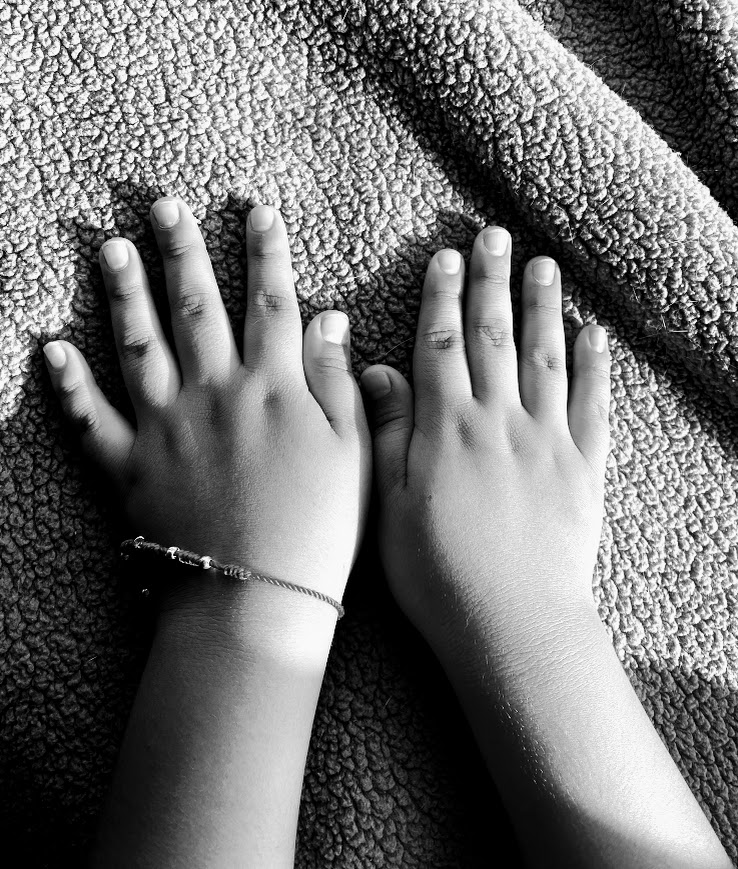
FOTO 1. Manos de Abigail

Día 2. Sábado 30 de enero de 2021

¡No sé qué pasa! Un hombre me está intentando cargar. Yo me aferro a los brazos de mi mamá, comienzo a llorar, estoy muy asustada, le grito a mi mamá. Ella está llorando. El hombre me sostiene en sus brazos. Mi mamá me habla fuerte. Me dice que me vaya con ese señor, que él me va a cuidar, que todo va a estar bien, que ella me va a ver del otro lado. Ese hombre me jala, me arrebata y me aleja de mi mamá. Alcanzo a oír que ella me dice “Te amo hija, cuídate”. Me doy cuenta de que estamos en un centro comercial. 

Aún es de noche. Todo es muy confuso, no sé qué pasa. No me gusta. ¿Es así como viajan las personas? ¿A dónde me llevan? Me siento en shock, mi corazón da un salto como “bip”. Tengo miedo, estoy muy preocupada por mi mamita que está llorando. ¿Por qué me soltó, y me dio a este señor? Aquel hombre me lleva a una camioneta donde hay otros niños más grandes que yo. Me quita mi mochilita. Me dice que se la va a dar a mi mamá. Trato de estar tranquila, y de portarme bien, como me dijo mi tía Ana, pero mis lágrimas todavía caen por mis cachetitos. 

El camino es largo, creo que me quedaré dormida. Llegamos a una casa con otras personas y otros niños. Nos preguntan si nos hacemos pipí en la cama. Yo contesto que no. Nos dan huevito con cátsup, y nos mandan a dormir con zapatos a un cuarto. Aunque hay más niños ahí me siento solita, estoy cansada. Quiero ver a mi mamá. ¿Dónde está mi mami?

Unas personas nos despiertan. No sé qué hora es. Tengo hambre. Nos dan galletas. Nos suben otra vez a la camioneta y nos llevan a otra casa. Hay otros niños más grandes. Una niña me dice que no la han recogido desde hace 7 días. También hay otra niña que lleva en brazos a su hermanita bebé. 

Llegamos a otra casa, con otros niños. No me acuerdo qué nos dieron de comer. De aquí, otra vez nos llevan a otra casa. No recuerdo a cuantas casas nos han llevado. Me acurruco en mí misma. Tengo sueño.

Empiezo a oler a comida, mamá Ruby, mi abuelita, mamá de mi mamá, está preparando el desayuno. Ella me levanta, me viste y me dice que ya es hora de ir al campo. Mis primos y yo desayunamos. Es un día bonito, huele a tierra y a leña quemada. 

Mamá Ruby nos sube a mis primos y a mí a la carreta. Ella se sube y grita a los burros para que nos jale. Comenzamos a reír. La carreta se sacude tanto al pasar por el camino de tierra y piedras que brincamos y vibramos. Hacemos sonidos con la voz. ¡Aaa-aaa-aaaah! Eee-eee-eeeeh! ¡Qué divertido! Después de recoger la alfalfa y llenar la carreta regresamos a casa. Me siento la niña más feliz.

FOTO 2. Pies de Abigail

Día 3. Domingo 31 de enero de 2021

Abro los ojos, las personas nos despiertan a todos. Me doy cuenta de que estuve soñando. Es muy temprano, nos levantan para llevarnos otra vez a otra casa. 

Finalmente, a una niña y a un niño casi de mi edad, nos dejan en una casa de personas ricas, lo digo por la casa. Es una casa de ladrillos rojos, muy bonita. Al entrar veo unas escaleras grandes que suben en curva como en las del castillo de las princesas, arriba hay una lámpara con luces que brillan como diamantes. La casa huele como a flores, el aroma me hace recordar las rosas. Después de mí, llega una niña y un niño más grandes que yo. Las personas nos gritan y nos dicen que no toquemos nada, y que no podemos quitarnos la ropa ni los zapatos. Nos dan sopita de letras calientita. La sopita me hace recordar la que me hacía mamá Ruby. Me pongo triste.

La señora que nos atiende me parece que es americana pero también se ve como mexicana. ella tiene pelo castaño, es gorda con pechos grandes, y es muy enojona. Ella vive con sus hijos, dos muchachas y un muchacho. Ellos me cambiaron mi nombre, ahora me llaman Cristal. Nos ponen a ver la televisión. Yo esperaba ver a mi mamá o a mi papá, pero ellos no están aquí. Me dan otra ropa para cambiarme. Ahora visto un pants completo color gris. No sé dónde quedó mi chamarrita.

Extraño mucho a mi mami, a mí abuelita, a mis primos, a mis tíos. Trato de pensar en cosas bonitas. Recuerdo cuando una vez mis primos, mi perrita Nena y yo viajábamos en la carreta después de ir al campo de alfalfa. De pronto, Nena saltó al camino de tierra. Todos le gritábamos “corre Nena, corre”. Y mi perrita corría para tratar de alcanzarnos. ¡Jajaja, eso fue muy divertido!

Me acuerdo también cuando mis primos Juan y José, y yo pastoreábamos a los borregos, uno de esos animales me persiguió, me empujó en las pompas, me caí y mi cara se llenó de tierra, pero no lloré. Todos nos reímos mucho. Otro día, al regresar del campo nos agarró la lluvia, todos mis primos corrimos rápido sobre el lodo, nos perseguía la Nena y otros perros. Al llegar a casa nos bañaron, a mí me tuvieron que poner unos pantalones secos de mis primos para que no me enfermara. ¡Me veía muy chistosa!

Sonrío, pero no dejo de sentirme triste. Ya no quiero estar aquí con estas personas. Quiero llorar, pero no debo porque no quiero que me regañen. Para dormir, me dejan sola en un cuarto, y me dan un peluche. Ya terminó otro día. No sé cuándo veré a mi mamá. ¿Qué le habrá pasado a ella? ¿Dónde está? ¿Por qué no viene por mí? 

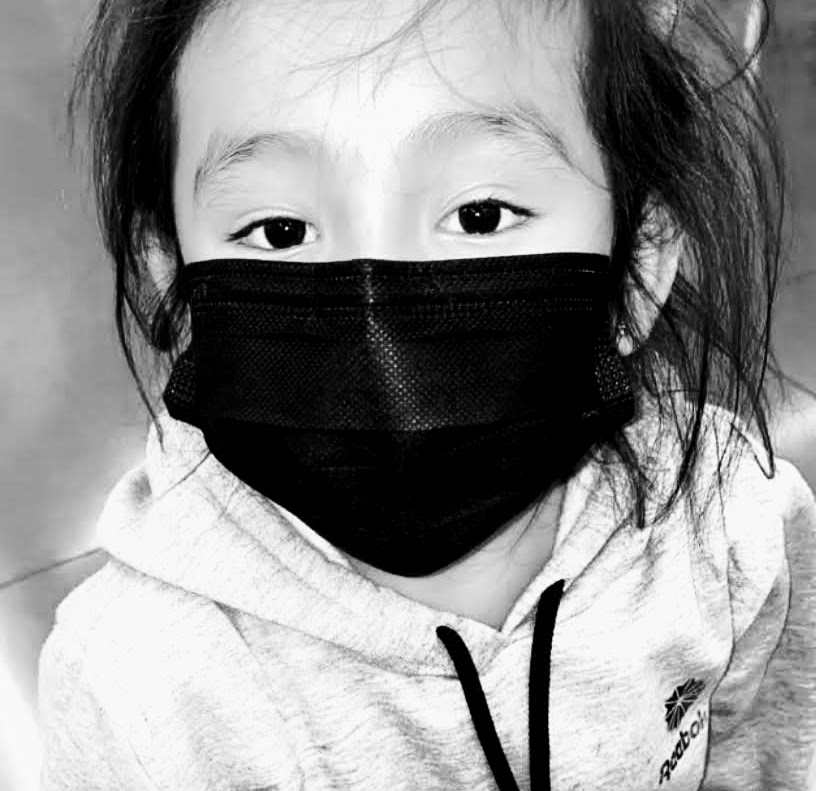
FOTO 3. Abigail con tapabocas

Día 4. Lunes 1 de febrero de 2021

Muy temprano la señora nos despierta a la niña y a mí, y luego al niño. Me da una galleta y un licuado. Quiero más comida, pero sabemos que no podemos pedir más. Unas mujeres llegan a la casa, y nos dicen que vamos a ir al Walmart. Nos dan una pastilla. Me dicen “trágatela”. Yo obedezco. Nos suben a un carro. Iniciamos el camino. Me quedo dormida.

Despierto, ya llegamos. Me ponen un tapabocas. Un señor me lleva de la mano a los baños del Walmart. Ahí veo a una señora, ella dice que es mi tía Paty, yo no la reconozco. Pero después de un momento me acuerdo de ella. ¡Sí, sí es ella, es mi tía Paty, hermana de mi mamá!

Tenía mucho tiempo de no verla. En cuanto la reconozco me suelto del señor y me abrazo con ella, comienzo a llorar con mucho sentimiento, ya no puedo contener todo lo que siento en mi pecho: miedo y tristeza. Mi tía me pregunta, “hija, ¿te hicieron algo, te tocaron, te trataron bien?” Yo le respondo, “estoy bien, no me hicieron nada, me trataron bien”. Me toma una foto, y luego habla por teléfono. Ya no vi a los otros niños, ya no supe a dónde los llevaron, espero que también ya estén con su familia. 

Le digo a mi tía y a su esposo que tengo mucha hambre. Salimos de ahí y me llevan al McDonald’s. Pido una cajita feliz. Qué rico me sabe la comida. Me siento mejor, pero quiero ver a mi mamá. Al terminar, mis tíos me llevan a su casa. Me dicen que pronto la veremos, pero que por ahora viviré con ellos. Me siento más tranquila y contenta. Mis tíos son muy buenos conmigo. Ahora sé que pronto estaré con mi mami.

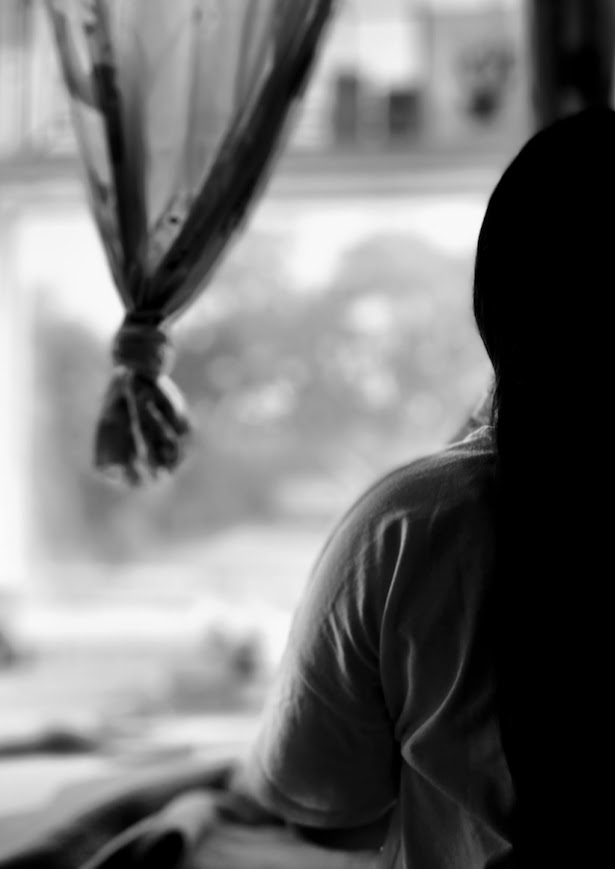
FOTO 4. Abigail a la ventana

Hoy

Abigail se encontró con su tía Paty en un pueblo del estado de California, Estados Unidos, a las 7 de la mañana. A un mes de cumplir sus 6 años.

Después de cinco días en casa de sus tíos, Abigail fue a la casa de su abuelo materno, ahí se encontró con su mamá, después de que ella pudo cruzar la frontera trepando el muro, y de saber que su hija había llegado sana y salva al “otro lado” con su hermana.

Actualmente Abigail tiene 9 años, vive con sus papás en un pueblo de Pensilvania. Asiste a la escuela, donde por algún tiempo sufrió de bullying por parte de sus compañeros blancos y negros. Ella sigue luchando por integrase a la vida americana. Todos los días se esfuerza mucho para seguir aprendiendo, y para leer y escribir en inglés, e incluso en español. Le gusta pintar, cantar, bailar; comer pastel, ramen y pozole. Quiere llegar a ser pintora, gimnasta y científica. Aunque extraña mucho su casa y a su familia de México, ella ya tiene nuevos amigos, y ahora pertenece a una comunidad latina que la acepta, la quiere y la admira.

A veces, Abigail mira por la ventana y recuerda con lágrimas esos “cuatro días inolvidables”. Sabe que todo eso ya pasó, y que su alma sanará pronto. Pero, aún sigue preguntándose por qué la gente tiene que sufrir así para “estar mejor”.

“El campo verde con sol y el olor a tierra de mi pueblo es diferente al de aquí. Me gusta la naturaleza que veo ahora, pero extraño ir a los campos de alfalfa, extraño a mi abuelita y a mis primos. Aquí también puedo comer lo que comía en mi pueblo porque mi mamá cocina comida mexicana muy rica. Ya sé hablar otro idioma, y ayudo a mi mami a comunicarse las personas. Me siento contenta de vivir aquí. Estoy con mi papá, pero ahora estoy sin mis hermanos. No sé qué pensar. ¿Valió la pena viajar así?”.

P.D. Nunca se supo dónde quedó la mochilita.

English Version:

Four unforgettable days for Abigail

Day 1. Friday, January 29, 2021

I wake up. My eyes are still closed. I want to stay lying in my little bed. A little bed that my older brother left me when he grew up. I pull and hug my warm Trolls blanket. I see the sunlight through the curtains out of the corner of my eye. I live with my mom and my brothers, in a small town in the state of Puebla. My dad isn’t here, he doesn’t live here. I don’t even remember when he left.

My mom wakes me up to take me to kindergarten. I have a roll and a smoothie for breakfast. Today they braided my hair like a headband and a ponytail. We leave. We get on the minivan. I really like my school, it has lots of colors on the wall, and it has a big patio. I have lots of friends.

My mom picks me up from kindergarten and we go home. She is very quiet. We get home, I get dressed in black leggings, a black sweater with gray sleeves, decorated with pink letters. I put on my white tennis shoes. My mom tells me to say goodbye to my siblings. I don’t understand, I feel confused. She tells me that today we will go see my dad. I feel happy, but I also feel sad because I have to say goodbye to them, my brother and my sister. They are just a little older than teenagers.

I grab my Lele doll backpack. The one my sister gave me. I put pajamas, some clothes, and some toys in it. That’s all. I hang my backpack and my unicorn jacket on. I see everyone sad, but they don’t cry. I feel excited. We put on a face mask to protect ourselves from the “covi.” My mom takes my hand. We leave the house.

We take the minibus. We arrive at the town of Tecamachalco. Then we get on a bus to Mexico City. We arrive. It’s 7 at night. We’re at the airport. There we meet my aunt Ana, my mom’s sister. She loves me very much and I love her very much. When she comes to visit me, she bathes me, plays with me, and makes me a little airplane.

My aunt argues with my mom, she doesn’t want me to go. She’s very sad and cries, but I don’t know why. I’ll go see my dad and then I’ll come back. Finally, she kisses me, makes the sign of the cross, puts my mask back on. She tells me to behave. We say goodbye. My mom and I get on the plane. I’ve never traveled like this. How exciting it is to look out the window, it seems like I’m the one flying!

We arrive at the city of Mexicali. It’s 10 at night. I’m sleepy. We’re waiting for a car. My mom says it will take us to another place. Finally the car arrives. A man opens the door. We get in the back. My mom hugs me and I try to sleep.

Day 2. Saturday, January 30, 2021

I don’t know what’s going on! A man is trying to pick me up. I cling to my mom’s arms, I start to cry, I’m so scared, I scream at my mom. She’s crying. The man holds me in his arms. My mom talks to me loudly. She tells me to go with that man, that he’ll take care of me, that everything will be okay, that she’ll see me on the other side. That man pulls me, snatches me away from my mom. I can hear her say, “I love you, daughter, take care of yourself.” I realize we’re in a shopping center.

It’s still nighttime. Everything is very confusing, I don’t know what’s going on. I don’t like it. Is this how people travel? Where are they taking me? I feel in shock, my heart skips a beat. I’m scared, I’m very worried about my mommy who’s crying. Why did she let go of me and give me to this man? That man takes me to a van where there are other children older than me. He takes my backpack from me. He tells me that he is going to give it to my mother. I try to be calm and behave, like my aunt Ana told me, but my tears are still running down my cheeks.

The road is long, I think I will fall asleep. We arrive at a house with other people and other children. They ask us if we wet the bed. I answer no. They give us an egg with ketchup, and they send us to sleep in a room with shoes on. Even though there are other children there, I feel alone, I am tired. I want to see my mother. Where is my mommy?

Some people wake us up. I don’t know what time it is. I’m hungry. They give us cookies. They put us back in the truck and take us to another house. There are other older children. A girl tells me that they haven’t picked her up for 7 days. There is also another girl who is carrying her baby sister in her arms.

We arrive at another house, with other children. I don’t remember what they gave us to eat. From here, they take us to another house again. I don’t remember how many houses they took us to. I curl up. I’m sleepy.

I start to smell food, Mama Ruby, my grandmother, my mother’s mother, is preparing breakfast. She gets me up, dresses me, and tells me that it’s time to go to the fields. My cousins ​​and I have breakfast. It’s a beautiful day, it smells like earth and burnt wood.

Mama Ruby puts my cousins ​​and me in the cart. She gets on and yells at the donkeys to pull us. We start to laugh. The wagon shakes so much as it goes over the dirt and rocky road that we jump and vibrate. We make sounds with our voices. Aaa-aaa-aaaah! Eee-eee-eeeeh! How fun! After we gather the alfalfa and fill the wagon we return home. I feel like the happiest girl.

Day 3. Sunday, January 31, 2021

I open my eyes, people wake us all up. I realize I was dreaming. It’s very early, they wake us up to take us to another house again.

Finally, a girl and a boy almost my age are left in a house of rich people, I say this because of the house. It’s a red brick house, very pretty. When I enter I see some large stairs that go up in a curve like those in the princess castle, above there is a lamp with lights that shine like diamonds. The house smells like flowers, the aroma reminds me of roses. After me, a girl and a boy arrive, older than me. People shout at us and tell us not to touch anything, and that we can’t take off our clothes or shoes. They give us warm alphabet soup. The soup reminds me of the one that Mama Ruby used to make me. I feel sad.

The lady who serves us seems to me to be American but she also looks Mexican. She has brown hair, is fat with big breasts, and is very angry. She lives with her children, two girls and a boy. They changed my name, now they call me Cristal. They put us on television. I expected to see my mom or my dad, but they are not here. They give me another outfit to change into. Now I am wearing a full set of gray sweatpants. I don’t know where my little jacket is.

I miss my mom, my grandmother, my cousins, my uncles a lot. I try to think of nice things. I remember when one time my cousins, my dog ​​Nena and I were traveling in the wagon after going to the alfalfa field. Suddenly, Nena jumped out onto the dirt road. We all yelled “run Nena, run.” And my dog ​​ran to try to catch up with us. Hahaha, that was so much fun!

I also remember when my cousins ​​Juan and José and I were herding sheep, one of those animals chased me, pushed me in the buttocks, I fell and my face was covered in dirt, but I didn’t cry. We all laughed a lot. Another day, when we came back from the field, we got caught in the rain, all my cousins ​​ran fast through the mud, Nena and other dogs chased us. When we got home, they bathed us, they had to put some dry pants on me from my cousins ​​so I wouldn’t get sick. I looked so funny!

I smile, but I can’t stop feeling sad. I don’t want to be here with these people anymore. I want to cry, but I can’t because I don’t want to be scolded. To sleep, they leave me alone in a room, and give me a stuffed animal. Another day is over. I don’t know when I’ll see my mom. What has happened to her? Where is she? Why isn’t she coming for me?

Day 4. Monday, February 1, 2021

Very early the lady wakes up the girl and me, and then the boy. She gives me a cookie and a smoothie. I want more food, but we know we can’t ask for more. Some women come to the house, and tell us we’re going to Walmart. They give us a pill. They tell me “swallow it.” I obey. They put us in a car. We start the journey. I fall asleep.

I wake up, we’ve arrived. They put a mask on me. A man takes me by the hand to the Walmart bathrooms. There I see a lady, she says she’s my aunt Paty, I don’t recognize her. But after a moment I remember her. Yes, yes it’s her, she’s my aunt Paty, my mom’s sister!

I hadn’t seen her for a long time. As soon as I recognize her I let go of the man and hug her, I start to cry with a lot of feeling, I can’t contain everything I feel in my chest anymore: fear and sadness. My aunt asks me, “Daughter, did they do anything to you? Did they touch you? Did they treat you well?” I answer, “I’m fine. They didn’t do anything to me. They treated me well.” She takes a photo of me and then talks on the phone. I didn’t see the other children anymore. I don’t know where they took them. I hope they are with their families now.

I tell my aunt and her husband that I’m really hungry. We leave and they take me to McDonald’s. I order a Happy Meal. The food tastes so good. I feel better, but I want to see my mom. When we’re done, my uncles take me to their house. They tell me that we’ll see her soon, but that for now I’ll be living with them. I feel calmer and happier. My uncles are really good to me. Now I know that I’ll be with my mom soon.

Today

Abigail met her aunt Paty in a town in the state of California, United States, at 7 in the morning. One month after her 6th birthday.

After five days at her uncles’ house, Abigail went to her maternal grandfather’s house, where she met her mother, after she was able to cross the border by climbing the wall, and after learning that her daughter had arrived safely on the “other side” with her sister.

Abigail is currently 9 years old, and lives with her parents in a town in Pennsylvania. She attends school, where for some time she suffered bullying from her white and black classmates. She continues to fight to integrate into American life. Every day she works hard to continue learning, and to read and write in English, and even in Spanish. She likes to paint, sing, dance; eat cake, ramen and pozole. She wants to become a painter, a gymnast and a scientist. Although she misses her home and her family in Mexico, she has new friends and now belongs to a Latino community that accepts her, loves her and admires her.

Sometimes, Abigail looks out the window and remembers with tears those “four unforgettable days.” She knows that all that is over, and that her soul will heal soon. But she still wonders why people have to suffer like this to “feel better.”

“The green fields with sun and the smell of earth in my town are different from here. I like the nature I see now, but I miss going to the alfalfa fields, I miss my grandmother and my cousins. Here I can also eat what I used to eat in my town because my mom cooks delicious Mexican food. I can now speak another language, and I help my mom communicate with people. I feel happy to live here. I am with my dad, but now I am without my brothers. I don’t know what to think. Was it worth traveling like that?”

P.S. It was never known where the backpack was left.

LA MONEDA (VIII-X)

RevarteColectiva · September 30, 2024 · Leave a Comment

Por Obed Arango

Click here for English version

“Ausencia”, Foto por Obed Arango

VIII

9-29-21 Ernesto, mira la moneda en su estudio, esta vez no la saca de su caja de rapé, en la nostalgia que le envuelve los viernes en la tarde cuando todo se hace silencio en él, aun guarda una esperanza de encontrarse con Ana Luisa, el amor de su vida. Ella  desapareció como los desparecidos de Buenos Aires bajo el régimen de Videla. Desapareció como si un portal en el tiempo la hubiera llevado a los días de Maximiliano, de Juarez o de Porfirio y caminó por la historia con ellos. 

Se sirve un vino tinto, y corta un trozo de chocolate.  Rodeado de papeles, y de pistas, piensa cuál es su siguiente paso. Ramiro el viejo ebanista quizá ya murió, han pasado 44 años desde el golpe de estado, si el hombre tenía 50, hoy es un carpintero de 94, las madres de ayer, hoy son abuelas y bisabuelas, y las hijas desparecidas viven en la memoria del pueblo. 

Pero Ana Luisa es distinta, sí, está desaparecida, pero es una memoria viva en la que tiene aun presente su fragancia, su voz, su risa, la mirada de sus ojos, el pensamiento profundo e inteligente, y la forma intima de cómo se excita y se pierde en el orgasmo con un grito final, puede aun sentirla temblorosa en sus brazos en la oscuridad, ella yace exhausta. El está exhausto en su agonía. Olvidarla no es opción. 

IX

Ernesto contempla la moneda.

X

(11-26-21)

Inquieto esa mañana de primero de junio de 1978, Carlos va a la vitrina y observa la colección del poder. Por primera vez contempla la moneda en silencio. Antes había visto la moneda, esta vez la contempla, la saca de su caja de rapé y la coloca en su dedo. Como un instante recorre la historia en él, puede ver a Maximiliano exclamando de gozo, puede escuchar la voz de Don Porfirio dando órdenes, puede ver el rostro Carmelita perdida con los ojos en la techumbre mientras el viejo Porfirio muestra ser un hombre recio. Puede recordar a Videla entregando la moneda y confiriendo el control de su aparato represivo.

Esa mañana por impulso llevó a Ana Luisa a la Casa Rosada, ¿por qué lo hizo? No lo podía saber, solo quería compartir un rato con su hija, hacerla sentir especial, seguro Videla estaría feliz de verla, que ella pudiera correr entre los pasillos y entre los salones, saltar y sonreir como una princesa. Y así lo hizo, Carlos llevo a Ana Luisa, la subio al despacho de Videla, el dictador la vio con sorpresa, pero con agrado. Hasta el mismo general se derretía ante los encantos de la niña de ojos verdes, cuyas luciérnagas se desplegaba como banderas de luz. 

— Necesito hablar con tu padre, ¿Por qué no vas por allá quizá encuentres a un viejo amigo?

La adolescente salió saltando y al cruzar el pasillo continuo al despacho de Videla, la niña no parecía intimidarse por la suntuosidad del edificio marcado por maderas finas en sus remates. Ahí estaba a unos metros de ella su gran amigo. Ana Luisa dejo de saltar y soltó un grito de alegría, “Don Ramiro” exclamo. Don Ramiro que justo estaba apunto de usar el taladro de mano casi lo suelta desde la altura del andamio y para su sorpresa mira hacia abajo a esa niña de rubia cabellera que llama su nombre de la manera más dulce que alguien puede hacer. Don Ramiro interrumpió su trabajo y bajo, se sacudió las manos y le extendió un saludo a Ana Luisa, que a su vez se olvido de formalidades para abrazarlo como quien abraza a un abuelo. Ana Luisa nunca tuvo uno, nunca conocio a los padres de Carlos ni de Ana María. Don Ramiro era lo más cercano a un abuelo para ella. No cabía de la sorpresa Don Ramiro cuando ella le tomó la mano y le pregunto por qué trabajaba ahí, a los que el contesto “para que esta casa cuando sea para todos, se vea linda como un palacio”. La niña escuchó pero no pensó mucho las palabras del carpintero y le propuso una idea descabellada. 

— Don Ramiro en nuestro camino para acá vi a un grupo de mujeres con pañuelos blancos en la cabeza caminar en círculo frente a la casa. Pregunté a mi padre quienes eran pero no me respondió, no dijo nada. Los pañuelos de ellas son como el que usted me dio para sanar mi herida. ¿Podemos ir afuera para verlas? ¿Iría usted conmigo? Quiero saber quienes son. 

Don Ramiro se sorprendió de la propuesta de la niña, tembló porque sabía que su hermana estaría ahí. ¿Qué pasaría si le reconoce? ¿qué pasaría si le saluda con la niña en la mano? 

Don Ramiro se negó al inicio argumentando que tenía mucho trabajo, pero ante la insistencia de la niña se acercó al despacho y pidió al guardia pedir hablar con Don Carlos. Un par de minutos después estaban la niña y Don Ramiro dentro del despacho desde donde se veía la plaza de mayo. 

— Papá quiero ir con Don Ramiro a caminar, ¿me dejas? 

Carlos que se encontraba pensativo solo afirmó. Y dijo, — sí está bien, vayan.

El carpintero y la adolescente bajaron las amplias escalinatas, vieron los grandes muros,  cruzaron cada puerta vigilada y se encontraron afuera del enrejado. ¿Por qué había aceptado esa locura? La niña le jalo de la mano y pronto se posicionaron cerca del obelisco de mayo  en el que las mujeres daban vueltas. Don Ramiro vio a su hermana, y con el dedo en la boca le pidió silencio. La hermana vio al carpintero con la adolescente. Ana Luisa observaba y leía algunas pancartas, nombres, muchos nombres entre los que se intercalaba el nombre de unas madres “Azucena Villaflor”. Qué bello nombre pensó la niña que era una pequeña poeta, el nombre de una flor con un jardín o una villa del mismo nombre. Por un momento las madres le parecieron todas flores de azucenas blancas que caminaban en círculo como un jardín en movimiento. Ana Luisa no sabía porqué caminaban, no entendía lo que pasaba, pero lo que veía frente a sus ojos era una de las más bellas y poderosas imágenes que jamás olvidaría, que marcaría su historia, un jardín lleno de flores que caminan.

Don Ramiro vio en los ojos de Ana Luisa un amor profundo por esas madres, la pequeña poeta buscaba las palabras. Él, le jaló levemente  la mano y le pidió que regresaran, ya habían pasado varios minutos desde que salieron y seguro la junta de su padre con el general había terminado. Regresaron al palacio, cruzaron cada puerta, cada muro, y él se sintió como si iba rumbo al matadero. Cómo explicaría frente a su padre y frente al general lo que habían visto. La niña le repetía, “Don Ramiro, son todas como flores de azucena que caminan en círculo, son un jardín en movimiento”. Don Ramiro, se puso en una rodilla y le prometió que le explicaría, pero que  adentro no quería que comentara porque no deseaba interrumpir la conversación del general con su padre. Así fue, Ana Luisa se quedó con el carpintero cerca del andamio, hasta que al cabo de unos minutos Carlos salió del despacho presidencial, encontró a Ana  Luisa, saludo a Don Ramiro y salió apresurado, Ana Luisa solo pudo agitar su mano y con los ojos decir adiós. 

Don Ramiro se sentó en el andamio para tomar un respiro cuando el general Videla llamó su nombre, “Don Ramiro, qué trabajo tan magnífico”. El carpintero sólo inclinó su cabeza en señal de gracias y recogió sus herramientas y salió. 

Ana Luisa aún sentía la sensación de las manos callosas de Don Ramiro, las manos de ella en cambio eran tiernas, libres de marcas, suaves, pero las de él eran fuertes, marcadas, con cicatrices y con una piel dura. Ella se sintió protegida por esas manos y se preguntaba si así era tener un abuelo. 

En el camino Carlos no decía nada, pero observaba a su hija que miraba todo por la ventana, y se dio cuenta que ella despertaba al mundo, ya no podía crecer solo entre las paredes de la casona o en los viajes a la casa de Mar de Plata. Ana Luisa se convertía en una mujercita, en una bella adolescente. 

La encomienda de Videla a Carlos era mantener a raya las protestas durante el mundial, si era necesario acelerar el encarcelamiento de los jóvenes, sofocar las protestas, y desprestigiar a las molestas madres lo hiciera, sin misericordia y sin titubeos. Carlos decidió infiltrar jóvenes al movimiento para conocer de fondo quiénes eran esas madres, y cuáles eran sus planes. Mientras los ojos de Carlos se perdían en el horizonte y pensaba en cómo apabullar a ese movimiento de pañuelos blancos, en el mismo auto también Ana Luisa perdía su mirada en el cielo con la imagen mágica de un jardín en movimiento. Padre e hija eran opuestos, miraban distinto la vida y los tiempos. 

Los siguientes días Ana Luisa pidió a su madre que la llevará a la biblioteca Municipal  Miguel Cané, ese era uno de sus lugares favoritos, se perdía entre esos muros llenos de libros. Le gustaba sentarse en esos pequeños estudios y leer. Ahí es donde vio nuevamente a las madres quienes entregaban volantes impresos en mimeógrafo, y en el que denunciaban las desapariciones de miles de jóvenes. Los transeúntes se alejaban de ellas, otros de manera sigilosa se acercaban para tomar un papel que doblaban rápidamente y se lo metían al pantalón o entre la falda. Todos sabían que ellas eran observadas, pero esas madres valientes se sentían ya muertas en vida, con un dolor intenso que cargaban a cuestas, sus hijos, sus hijas desaparecidas. Ana Luisa comenzó a entender y a atar cabos. ¿Quién era el general Videla en realidad? ¿Por qué estas mujeres lo acusan de asesino? ¿Por qué su padre, ese hombre que tanto ha admirado es amigo del general? ¿Por qué va todo el tiempo a la Casa Rosada? ¿Por qué Don Ramiro trabaja allá? Todas estas interrogantes ondulaban por su cabeza, como pensamientos que iban y venían, mareaban su entender, y le daba miedo saber las respuestas. 

“Ernesto, tú no has vivido una revolución como yo la viví”, recordaba Ernesto aquella tarde de verano en que ella le preguntaba si se atrevería a tomar las armas. Ernesto, sabía que la respuesta estaba en Argentina. 

English Version:

“Amanecer”. Foto por Obed Arango. 

VIII

9-29-21 Ernesto looks at the coin in his study, this time he does not take it out of his snuff-box; in the nostalgia that envelops him on Friday afternoons when everything falls silent within him, he still maintains a hope of finding himself with Ana Luisa. She disappeared like the disappeared of Buenos Aires under Videla’s regime. She disappeared as if a portal in time had taken her to the days of Maximilian, Juarez, or Porfirio and she walked through history with them. 

He pours a glass of red wine and cuts a piece of chocolate. Surrounded by papers and clues, he thinks about his next step. Ramiro, the old cabinetmaker, may have already died; 44 years have passed since the coup d’état, and if the man was 50 then, he must now be a 94-year-old carpenter. Yesterday’s mothers are today’s grandmothers and great-grandmothers, and the missing daughters live in the town’s memory.

But Ana Luisa is different. Yes, she is missing, but she is a living memory in the way her fragrance, her voice, her laughter, the look in her eyes, her deep and intelligent thoughts, and the intimate way in which she excites and loses himself in orgasm with a final scream. He can still feel her trembling in his arms in the darkness as she lies exhausted. He is exhausted in his agony. Forgetting it is not an option. 

IX

Ernesto contemplates the coin.

X

(11-26-21)

Restless that morning of June 1, 1978, Carlos goes to the display case and observes the collection of power. He had seen the coin before, but for the first time, he takes it out of his snuff-box and places it on his finger. He contemplates it in silence. For a moment, history passes right through him, and he can see Maximiliano exclaiming with joy, can hear the voice of Don Porfirio giving orders, can see the lost look on Carmelita’s face as she stares at the ceiling while old Porfirio shows himself to be a hardy man. He can remember Videla handing over the coin and conferring control of his repressive apparatus.

That morning, on impulse, he took Ana Luisa to the Casa Rosada. Why did he do it? He didn’t know, he just wanted to spend some time with her daughter and make her feel special; I’m sure Videla would be happy to see that she could run between the hallways and classrooms, jumping and smiling like a princess. And so Carlos took Ana Luisa up to Videla’s office; the dictator saw her with surprise and a hint of pleasure. Even the general himself melted before the charms of the girl with green eyes, whose fireflies unfurled like banners of light. 

— I need to talk to your father, why don’t you go over there? Maybe you’ll find an old friend.

The teenager jumped out and crossed the continuous hallway to Videla’s office; the girl did not seem intimidated by the opulence of the building, marked by fine wood in its finishes. A few meters away from her stood her great friend; Ana Luisa stopped jumping and let out a cry of joy, “Don Ramiro,” she exclaimed. Don Ramiro, who was just about to use the hand drill, almost dropped it from the height of the scaffolding, and to his surprise, he looked down at that girl with blonde hair who called his name in the sweetest way anyone could do. Don Ramiro interrupted his work and went downstairs, shook his hands, and greeted Ana Luisa, who in turn forgot about formalities and hugged him like a grandfather. Ana Luisa never had one, she never met Carlos’s or Ana María’s parents. Don Ramiro was the closest thing to a grandfather for her. Don Ramiro was beyond surprised when she took his hand and asked him why he worked there, to which he replied, “So that this house, when it is for everyone, looks beautiful like a palace.” The girl listened but did not think much about the carpenter’s words and proposed a crazy idea. 

— Don Ramiro on our way here I saw a group of women with white scarves on their heads walking in a circle in front of the house. I asked my father who they were but he didn’t answer me— he didn’t say anything. Their handkerchiefs are like the one you gave me to heal my wound. Can we go outside to see them? Would you go with me? I want to know who they are. 

Don Ramiro was surprised by the girl’s proposal. He trembled, as he knew that his sister would be there. What would happen if she recognized him? What would happen if she greeted him with the girl in his hand? 

Don Ramiro refused at first, arguing that he had a lot of work, but at the girl’s insistence, he approached the office and asked the guard to speak with Don Carlos. A couple of minutes later, the girl and Don Ramiro were inside the office from where the Plaza de Mayo could be seen. 

— Dad, I want to go for a walk with Don Ramiro, would you let me? 

Carlos, lost in thought, only responded — yes it’s okay, go.

The carpenter and the teenager went down the wide stairs, saw the great walls, crossed each guarded door, and found themselves outside the grating. Why had he accepted this madness? The girl pulled him by the hand, and soon, they were positioned near the May obelisk where the women were spinning. Don Ramiro saw his sister, and with his finger on his mouth, he insisted on her silence. The sister saw the carpenter with the teenager. Ana Luisa observed and read some banners, names, many names among which the names of some mothers were interwoven. “Azucena Villaflor”. What a beautiful name, the little poet thought; the name of a flower with a garden or a village of the same name. For a moment, the mothers seemed to him white lily flowers walking in a circle— like a garden in motion. Ana Luisa did not know why they were walking, she did not understand what was happening, but what she saw in front of her was the most beautiful and powerful image that she would never forget; it would mark her history, a garden full of walking flowers.

Don Ramiro saw in Ana Luisa’s eyes a deep love for those mothers, the little poet was searching for the right words. He lightly pulled her hand and asked her to return. Several minutes had passed since they left and surely, her father’s meeting with the general had ended. They returned to the palace, crossing every door, and every wall, and the further they went, the more he felt as if he was heading to the slaughterhouse. How would he explain what they had seen in front of her father and the general? The girl repeated to him, “Don Ramiro, they are all like lily flowers that walk in a circle; they are a garden in motion.” Don Ramiro got down on one knee and promised her that he would explain, but inside, he did not want her to comment because he did not want to interrupt the general’s conversation with her father. That’s how it went. Ana Luisa stayed with the carpenter near the scaffolding until after a few minutes, Carlos left the presidential office, found Ana Luisa, greeted Don Ramiro, and left in a hurry. Ana Luisa could only wave her hand and with her eyes, say goodbye. 

Don Ramiro sat on the scaffolding to catch his breath when General Videla called his name, “Don Ramiro, what a magnificent job.” The carpenter simply bowed his head in thanks, picked up his tools, and left. 

Ana Luisa still felt the sensation of Don Ramiro’s calloused hands; her hands, unlike his, were tender, free of marks, and soft; his were strong, marked with scars, and with rough skin. She felt protected by those hands and wondered if this was what it felt like to have a grandfather. 

On the way, Carlos didn’t say anything, but he watched his daughter as she looked out the window, and he realized that she was waking up to the world and could no longer grow up isolated within the walls of the house or on trips to their Mar de Plata house. Ana Luisa was blossoming into a young woman, a beautiful teenager. 

Videla’s assignment to Carlos was to keep the protests at bay during the World Cup, and if necessary, to accelerate the imprisonment of young people, quell the protests, and discredit the annoying mothers without mercy and without hesitation. Carlos decided to infiltrate young people into the movement to learn more about who these mothers were, and what their plans were. While Carlos’s eyes were lost in the horizon, thinking about how to overwhelm that movement of the white scarves, Ana Luisa was also losing her gaze in the sky with the magical image of a garden in motion. Father and daughter were opposites, they had different perspectives on life and time. 

The following days, Ana Luisa asked her mother to take her to the Miguel Cané Municipal Library, one of her favorite places; she loved to get lost among those walls of books. She liked to sit in those little studies and read. That’s where she saw the mothers again; they handed out leaflets printed on mimeograph machines, denouncing the disappearances of thousands of young people. Passerbys quickly moved away from them as others stealthily approached to take a leaflet before quickly putting it away. Everyone knew that they were being watched, but those brave mothers felt they were already dead in life— with the intense burden of their missing sons and daughters on their backs. Ana Luisa began to understand and connect the dots. Who was General Videla really? Why do these women accuse him of being a murderer? Why is her father, a man she has admired so much, a friend of the general? Why does she go to the Casa Rosada all the time? Why does Don Ramiro work there? All these questions waved through her head like thoughts that came and went, dizzying her understanding; she was afraid to find out the answers. 

“Ernesto, you have not experienced a revolution like I have,” Ernesto recalled that summer afternoon when she asked him if he would dare to take up arms. Ernesto knew that the answer was in Argentina. 

Obed Arango Hisijara

Obed es mexicano, ciudadano de la América Latina, artista visual y antropólogo. Director de CCATE y profesor de University of Pennsylvania.


Selected Works by Obed Arango:
La Moneda (I-III)
La Moneda (IV)
La Moneda (V)
La Moneda (VI)
La Moneda (VII)

    La máquina de coser de mamá (IV)

    RevarteColectiva · September 30, 2024 · Leave a Comment

    Por Rosalba Esquivel Cote

    Click here for English version

    IV. CAPÍTULO CUATRO. Ansiedad. Zurcidos de cambio.

    El tiempo continúa implacable. Por fortuna, a Rodri ya no se le oye toser. Mary se fue a dormir con él, acomodó la almohada con mucho cuidado y se recostó suavemente para no despertarlo. Quería atenderlo por si fuera necesario y no distraer a su mamá.

    Las luces de los faros que alumbraban la calle se hacían más intensas sobre las cortinas de la ventana. Las luces de los autos ya no competían con ellas. Poco a poco el vecindario se quedaba en calma y en silencio, uno que otro ladrido de los perros a lo lejos se hacían escuchar. De vez en cuando un tráiler de carga pasaba por la avenida haciendo vibrar toda la colonia.

    Kate se levantó por un momento para preparase un café, y para darle unas galletas Marías y un vaso de leche tibia a Rose, quien ya sentía el frío de la madrugada. La mamá se puso un suéter y le dio otro a la niña.

    Después de cuatro canciones más, los vestidos por fin estaban armados, ahora sólo hacía falta acabar de pegar los botones. En ese momento, Kate quitó la aguja y el hilo de las manitas de su hija y la mandó a dormir. Rose levantó la cara para mirar a su madre y le dijo “no”. La niña quería seguir ayudando, pero sus manos pequeñas suaves y frágiles se encontraban ya picoteadas por los pequeños accidentes que llegaba a darse con la aguja.

    Su madre la tomó de las manos y le dijo, “por hoy ya me ayudaste mucho, fuiste muy valiente y una gran compañera. Ahora descansa porque mañana te necesitaré muy temprano. Yo ya no tardaré”.

    Finalmente, Rose se fue a dormir, pero no en su cama, sino al lado de sus hermanos, con Mary y con Rodri. Tenía frío, y ellos estaban muy calientitos entre las cobijas de algodón, adornadas con cuadritos y grecas de colores con flequillos deshilados, que habían comprado hace algunos años en Chiconcuac, un municipio al noreste del Estado de México a unos cuantos kilómetros de la Ciudad de México. A la abuela de Rose le encantaban estas cobijas porque estaban hechas con la misma técnica desde la época prehispánica, y que hoy es un patrimonio económico y cultural.

    La niña se quedó por un momento observando a sus hermanos, durmiendo casi abrazados, se veían tan bonitos, pensó ella, un sentimiento de satisfacción la invadió porque sintió que ella, como hermana mayor había cumplido y había hecho algo por ellos. En ausencia de su padre, ella acompañó a su madre, y la ayudó a reparar la máquina de coser, ese artefacto que, por un lado, representaba una fuente de ingresos para la familia, pero por el otro, era el motivo por el cual veía que su madre se desgastaba cada día. “Quiero estudiar para ser alguien importante, trabajar y ganar dinero para dárselo a mi mamá”, dijo Rose. “Quiero que a mis padres y a mis hermanos nunca les falte nada”. Y con ese pensamiento noble y esperanzador, la niña, levantó las cobijas que se encontraban por debajo de los pies de Rodri y se acurrucó junto a él. 

    El sonido de la máquina de coser había cesado, ahora, sólo la música del radio se hacía escuchar levemente desde la cocina. Rose quiso mirar por última vez a su mamá y estar segura de que ella estaría pronto a terminar, pero el sueño la venció y pronto cayó en un sueño muy profundo.

    El tic tac de las manecillas del reloj que seguían avanzando se hacía más evidente en ese espacio donde el día se había alargado tanto. La luna brillaba en el cielo desde hace ya un buen rato, había hecho un relevo con el sol para que con su esplendor no dejara de alumbrar y “evitar” que el día terminara.

    Ya en silencio, Kate se quedó sola en aquella habitación de batalla. En el piso había una pila de decenas de vestiditos blancos; a un lado, aquella caja oxidada con la herramienta que les ayudó a reparar la máquina; cerca de la silla de Kate, el cuaderno abierto con los apuntes a lápiz de Rose; un poco más allá, el foco con la extensión de luz que la niña sujetó sin chistar durante la “operación”; hacía el otro lado, el banquito donde su hija trabajó sin parar; todo ello cubierto con hebras de hilo blanco. Y al frente, la máquina de coser se mostraba imponente, retadora, su salvador y su verdugo, pero sin duda como un maestro autoritario que enseña a no perder, a imponerse con carácter ante la adversidad, enseñando a no rendirse sin pelear.

    Zurcido tras zurcido, botón tras botón, las manecillas giraban marcando el inevitable avance del tiempo.

    Kate se quedó sola, con ella misma, y con la responsabilidad de terminar a tiempo con su misión. Con gran esfuerzo, se concentró en pegar cada botón perfectamente porque era posible que el cansancio la hiciera cometer errores, y no quería repetir el zurcido. Fue en ese momento que se acordó de su esposo. “Pobre, seguramente sigue trabajando y sintiendo tanto sueño y cansancio como yo. ¿Qué habrá pasado en la fábrica? ¿Qué extraño es que se quedara tan tarde a trabajar?”, se quedó un rato pensativa, sintiendo ya el frío en sus pantorrillas. Se levantó por unas medias, entró a la recámara donde los niños estaban durmiendo, se les quedó mirando un rato, sus caritas con las mejillas rosadas, sus cabellos despeinados, acurrucados como los perritos acabados de nacer. Cuanto los amaba.

    Rodri, rodeado de sus dos hermanas, esbozaba una leve sonrisa sujetando su dinosaurio de peluche; tal vez esté soñando con la celebración de su cumpleaños, se dijo Kate. Él es el más simpático y travieso de sus hijos, pero también el más besucón y el que siempre pedía un abrazo. 

    Luego miró a Mary, la más rebelde, a la que era difícil imponerle opiniones, siempre a la defensa de sus hermanos; ahí dormida le pareció la niña más hermosa del mundo, casi igualita a una de las muñecas que vestía; con esas gruesas trenzas negras que se hacía antes de dormir, marcaba bien su cara redonda y sus grandes ojos adornados con esas pestañas larguísimas. Aunque no le gustaba estudiar, siempre estaba dispuesta a ayudar en los quehaceres de la casa. 

    Y Rose, callada y observadora, nunca le ha dado motivo para un regaño, pensativa y concentrada en sus cuadernos, Kate se preguntaba, qué tanto pudiera pasar por la mente de esa cabecita, sabía que, a pesar de ser una niña, su hija, la de cabellos “pelos de elote” tenía su propio modo de ver la vida. 

    Kate arropó con esmero a sus hijos, pasó su mano por la frente de cada uno. Se dispuso a ponerse unas medias gruesas cafés en sus piernas, y continuar con su tarea.

    Al regresar a aquel campo de guerra, miró el reloj, miró los vestidos que aún les faltaban los botones, hizo un cálculo rápido y supo que era muy probable que terminara a tiempo, así que, suspiró y con ánimo renovado, se apresuró a terminar por fin. Planeó el modo de doblar los vestidos y acomodarlos sobre una sábana blanca desgastada para transportarlos sin que se arrugaran, y luego se preguntó “¿y cómo los llevaré? ¿y si Jorge no regresa a tiempo?”.

    Sus ojos se abrieron mirando a lo lejos porque se dio cuenta que si su esposo no estaba para llevarla con los vestidos tendría que conseguir un taxi seguro y pagarlo, pero… ella con tres niños y su carga, seguramente le querrán cobrar “las perlas de la Virgen”, seguramente los vestiditos se arrugarían, seguramente no llegaría a tiempo o seguramente terminaría pagando más de lo que ella cobraría por su trabajo. Todo esto pasaba por la cabeza de Kate, lo que la hizo sentir una gran ansiedad de momento. También le preocupaba lo que estaría pasando su esposo.

    El estrés fue tal que, sintió latidos más fuertes, sudoración pese al frío, lágrimas se asomaron en sus ojos, sintió mucho miedo; y sin más, se levantó, se dirigió a la puerta y la abrió frente al patio para sentir el aire fresco de la madrugada en la cara. Levantó su mirada al cielo y respiró profundo, cubrió su desesperación con sus manos, unas manos que hablaban del esfuerzo y del trabajo de una mujer que la hacían parecer más vieja de lo que realmente era. Cerró los ojos y por un momento quiso gritar su desventura, ¿por qué le pasaban esas cosas a ella?, se decía a sí misma. “Desde niña he tenido que luchar todos los días para sobrevivir, he sufrido hambre, frío y siempre carecí de la protección y cariño de mis padres, de una caricia de mi madre, con tantos hijos ella no tuvo el tiempo de atender a nadie, siempre trabajando, siempre ocupada, y yo sintiéndome tan sola en esa casa llena de gente. Confieso que en cuanto tuve la oportunidad, salí de ahí, Yorch fue la excusa perfecta, y sé que él venía de una situación similar. Reconozco que no estaba totalmente enamorada, pero ha sido un buen esposo y padre para mis hijos”.

    Pero, en cuanto la imagen de sus hijos se cruzó por su mente, sintió un golpe de alivio. Recordó lo feliz que los veía jugar con tan sólo unas tablitas de madera, unas muñequitas, algunos carritos, gises, y lápices de colores sin pedir nada más que el amor de sus padres y una sopita de fideo. Aquella horrible sensación se fue disipando, ese feo sentimiento se fue convirtiendo en esperanza, en ilusión. Pensó, “yo soy mejor que mis padres, yo soy más fuerte y luchona, he sido capaz de tener una familia feliz pese a las carencias, yo soy capaz de darles más, más amor y atención, yo soy mucha mujer, mucha madre y soy muy chingona”. Su gesto se transformó, y algo extraordinario pasó.

    English Version:

    IV. CHAPTER FOUR. Anxiety. Change darns.

    Time continues relentlessly. Fortunately, Rodri can no longer be heard coughing. Mary went to sleep with him, arranged the pillow very carefully and lay down gently so as not to wake him. He wanted to take care of him in case it was necessary and not distract his mother.

    The headlights that illuminated the street became more intense on the window curtains. The lights of the cars no longer competed with them. Little by little the neighborhood became calm and silent, the occasional barking of the dogs in the distance could be heard. From time to time a cargo trailer would pass by the avenue making the entire neighborhood vibrate.

    Kate got up for a moment to make coffee, and to give some Marias cookies and a glass of warm milk to Rose, who was already feeling the cold of the early morning. The mother put on a sweater and gave another to the girl.

    After four more songs, the dresses were finally assembled, now they just needed to finish gluing the buttons. At that moment, Kate removed the needle and thread from her daughter’s little hands and sent her to sleep. Rose raised her face to look at her mother and said “no.” The girl wanted to continue helping, but her small, soft and fragile hands were already pecked by the small accidents that occurred with the needle.

    Her mother took her by the hands and told her, “for today you have already helped me a lot, you were very brave and a great companion. Now rest because tomorrow I will need you very early. “I won’t be long.”

    Finally, Rose went to sleep, but not in her bed, but next to her brothers, with Mary and with Rodri. It was cold, and they were very warm between the cotton blankets, decorated with colorful squares and frets with frayed fringes, that they had bought a few years ago in Chiconcuac, a municipality in the northeast of the State of Mexico, a few kilometers from the City of Mexico. Rose’s grandmother loved these blankets because they were made with the same technique since pre-Hispanic times, and today it is an economic and cultural heritage.

    The girl stayed for a moment watching her brothers, sleeping almost in each other’s arms, they looked so pretty, she thought, a feeling of satisfaction invaded her because she felt that she, as an older sister, had fulfilled and done something for them. In her father’s absence, she accompanied her mother and helped her repair the sewing machine, that device that, on the one hand, represented a source of income for the family, but on the other, was the reason why he saw that his mother was wasting away every day. “I want to study to be someone important, work and earn money to give to my mother,” Rose said. “I want my parents and siblings to never lack for anything.” And with that noble and hopeful thought, the girl lifted the blankets that were under Rodri’s feet and snuggled up next to him.

    The sound of the sewing machine had stopped, now, only the music from the radio could be heard faintly from the kitchen. Rose wanted to look at her mother one last time and be sure that she would soon be finished, but sleep overcame her and she soon fell into a very deep sleep.

    The ticking of the clock hands that continued to advance became more evident in that space where the day had lengthened so much. The moon had been shining in the sky for quite some time, it had taken over from the sun so that with its splendor it would not stop shining and “prevent” the day from ending.

    Already silent, Kate was left alone in that battle room. On the floor there was a pile of dozens of little white dresses; On one side, that rusty box with the tool that helped them repair the machine; near Kate’s chair, the open notebook with Rose’s pencil notes; a little further, the spotlight with the extension of light that the girl held without saying a word during the “operation”; Towards the other side, the bench where his daughter worked non-stop; all covered with strands of white thread. And in front, the sewing machine appeared imposing, challenging, its savior and its executioner, but without a doubt like an authoritarian teacher who teaches not to lose, to prevail with character in the face of adversity, teaching not to give up without a fight.

    Darning after darning, button after button, the hands turned marking the inevitable advance of time.

    Kate was left alone, with herself, and with the responsibility of finishing her mission on time. With great effort, she concentrated on gluing each button perfectly because it was possible that fatigue would make her make mistakes, and she did not want to repeat the darning. It was at that moment that she remembered her husband. “Poor thing, he’s probably still working and feeling as sleepy and tired as I am. What happened at the factory? How strange is it that he stayed so late to work?” She remained thoughtful for a while, already feeling the cold on her calves. She got up to get some socks, went into the bedroom where the children were sleeping, looked at them for a while, their little faces with rosy cheeks, their hair disheveled, curled up like newly born puppies. How much I loved them.

    Rodri, surrounded by his two sisters, smiled lightly while holding his stuffed dinosaur; Maybe she’s dreaming about her birthday celebration, Kate told herself. He is the nicest and most mischievous of his children, but also the biggest kisser and the one who always asked for a hug. 

    Then he looked at Mary, the most rebellious, on whom it was difficult to impose opinions, always defending her brothers; Sleeping there she seemed to him to be the most beautiful girl in the world, almost like one of the dolls she was wearing; With those thick black braids that she did before going to sleep, she clearly marked her round face and her big eyes adorned with those very long eyelashes. Although she did not like to study, she was always willing to help with the housework.

    And Rose, quiet and observant, has never given her a reason to scold her, thoughtful and focused on her notebooks, Kate wondered, how much could go through that little head’s mind, she knew that, despite being a girl, her daughter , the one with “corn hair” hair had her own way of seeing life. 

    Kate carefully tucked her children in, ran her hand over each one’s forehead. She prepared to put some thick brown stockings on her legs, and continue with her task.

    Upon returning to that war field, she looked at the clock, looked at the dresses that were still missing the buttons, did a quick calculation and knew that it was very likely that she would finish on time, so, sighing and with renewed spirit, she hurried to finish. at last. She planned how to fold the dresses and arrange them on a worn white sheet so that they could be transported without wrinkles, and then she asked herself, “How will I carry them?” What if Jorge doesn’t come back on time?”

    Her eyes widened looking into the distance because she realized that if her husband was not there to take her with the dresses, she would have to get a safe taxi and pay for it, but… she with three children and her load, they would surely want to charge her for “the pearls of the Virgin”, surely the little dresses would wrinkle, surely she would not arrive on time or surely she would end up paying more than she would charge for her work. All of this was going through Kate’s head, which made her feel very anxious at the moment. She was also worried about what her husband was going through.

    The stress was such that he felt a stronger heartbeat, sweating despite the cold, tears appeared in his eyes, he felt very afraid; And without further ado, he got up, went to the door and opened it facing the patio to feel the fresh early morning air on his face. She raised her gaze to the sky and took a deep breath, covering her despair with her hands, hands that spoke of the effort and work of a woman that made her look older than she really was. She closed her eyes and for a moment she wanted to scream her misfortune, why did these things happen to her? she told herself. “Since I was a child I have had to fight every day to survive, I have suffered hunger, cold and I always lacked the protection and affection of my parents, a caress from my mother, with so many children she did not have the time to care for anyone, always working, always busy, and me feeling so alone in that house full of people. I confess that as soon as I had the opportunity, I got out of there, Yorch was the perfect excuse, and I know that he came from a similar situation. “I admit that I was not totally in love, but he has been a good husband and father to my children.”

    But as soon as the image of his children crossed his mind, he felt a rush of relief. He remembered how happy he saw them playing with just some wooden boards, some dolls, some cars, chalk, and colored pencils without asking for anything more than the love of their parents and a noodle soup. That horrible feeling was dissipating, that ugly feeling was turning into hope, into illusion. She thought, “I am better than my parents, I am stronger and more feisty, I have been able to have a happy family despite the shortcomings, I am capable of giving them more, more love and attention, I am very much a woman, very much a mother and “I’m very cool.” His gesture transformed, and something extraordinary happened.

    Rosalba Esquivel Cote

    Rosalba es mujer, mexicana, microbióloga, maestra, aprendiz, y artivista. “¡Deja que tus gritos se lean!”

    She is a woman, Mexican, microbiologist, teacher, apprentice, and artist. “Let your cries be read!”

    Selected Works by Aura R. Cruz Aburto:
    La máquina de coser de mamá (III)
    La máquina de coser de mamá (II)
    La Máquina De Coser De Mamá (I)
    Mi Amiga y La Medusa
    Otoño
      • « Go to Previous Page
      • Page 1
      • Page 2
      • Page 3
      • Page 4
      • Interim pages omitted …
      • Page 10
      • Go to Next Page »

      Hit the ground running with a minimalist look. Learn More

      Copyright © 2026 · Monochrome Pro on Genesis Framework · WordPress · Log in

      • Instagram
      • Facebook