
Ver todo el Número 8 / See the full issue →
Click here for English version

Un encuentro con Dolores Huerta
Por Obed Arango
Dolores Huerta, una de las grandes líderes sociales de origen mexicano y latino en Estados Unidos, falleció el pasado 28 de octubre a los 96 años. La noticia me alcanzó al mediodía, al llegar al Centro de Cultura, Arte, Trabajo y Educación (CCATE), espacio que un grupo de migrantes latinoamericanos fundamos hace quince años en Norristown, Pensilvania. Permanecí unos minutos afuera del edificio pensando en la huella que deja una mujer cuya vida estuvo dedicada a la búsqueda de la justicia social. Recordé entonces un encuentro breve pero significativo que tuve con ella años atrás y que hoy adquiere una dimensión distinta.
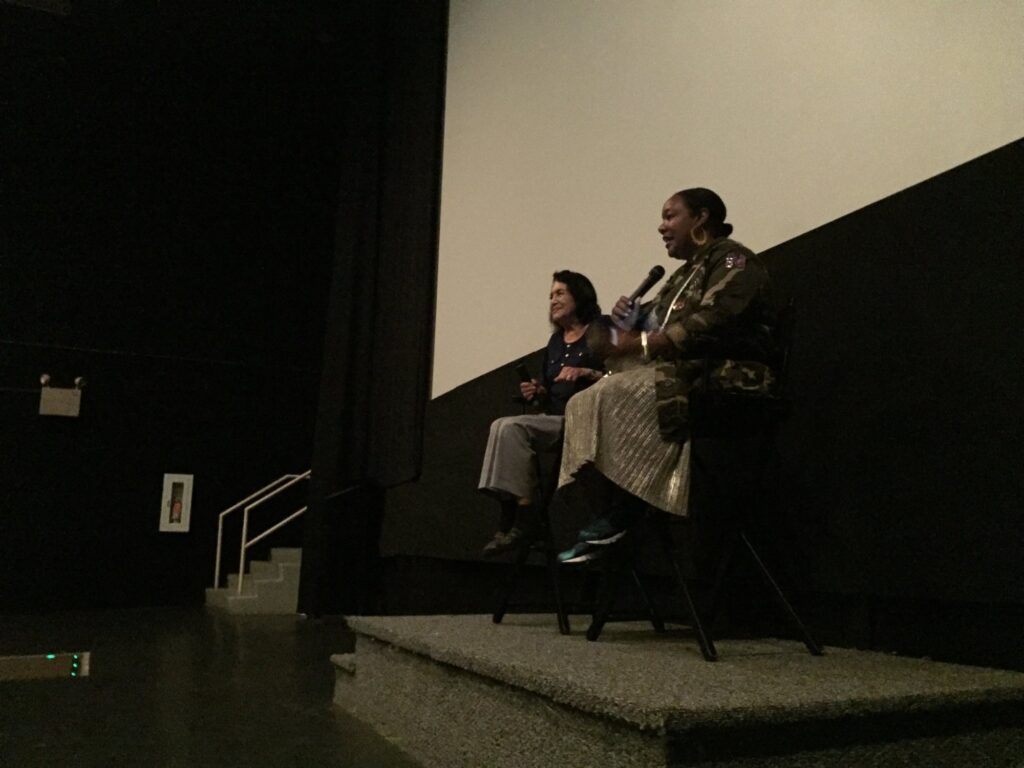
Fue un 16 de septiembre de 2017, durante las celebraciones de la independencia de México y Centroamérica, cuando Dolores Huerta visitó Filadelfia para la presentación del documental Dolores. Integrantes del círculo de lectura de CCATE y del grupo de las Artivistas conseguimos entradas para asistir a la proyección en el cine Ritz Five, en Old City. Después de la película habría un diálogo con la propia Huerta.
Su asiento estaba justo al lado del mío. Cuando llegó al recinto, poco antes de iniciar la conversación con el público, me pidió que la acompañara hasta el frente del auditorio. Se apoyó en mi brazo y caminamos mientras me preguntaba mi nombre. Al llegar, me pidió que permaneciera cerca.
El documental repasaba algunos de los episodios más importantes de una trayectoria extraordinaria. Huerta fue cofundadora, junto con César Chávez, de la organización que en 1962 dio origen al sindicato United Farm Workers, que transformó las condiciones laborales de miles de trabajadores agrícolas en Estados Unidos. Desde ahí impulsó huelgas, boicots y negociaciones que permitieron mejorar salarios y derechos para una población históricamente explotada e invisibilizada. Décadas después recibió la Medalla Presidencial de la Libertad, el máximo reconocimiento civil del país. Durante la ceremonia, el entonces presidente Barack Obama reconoció que el famoso “Yes We Can” tenía su origen en el histórico lema “Sí se puede” de Huerta.
Sin embargo, la lucha de Huerta no se quedó en la lucha sindical. Su trabajo la llevó a comprender que la explotación laboral estaba profundamente ligada a otras formas de opresión. Defendió los derechos de las mujeres, los inmigrantes, la comunidad LGBTQ+ y las personas trabajadoras de bajos ingresos. En el propio movimiento campesino observó cómo muchas mujeres sufrían discriminación, invisibilización y violencia. Décadas más tarde, y hace solo algunos meses, denunció haber sido víctima de abuso sexual por parte de César Chávez, una declaración que generó conmoción debido al lugar simbólico que ocupa el dirigente en la memoria colectiva.
Aquella denuncia obligó a revisar críticamente la historia de los movimientos sociales. Más que debilitar las luchas, las fortalece cuando se asume con honestidad. Huerta entendía que la justicia no puede construirse sobre silencios.
Durante las décadas siguientes participó en múltiples espacios feministas, aunque siempre mantuvo una visión propia. Consideraba que buena parte del feminismo dominante, encabezado por mujeres blancas de clase media y de entornos académicos, no reflejaba las experiencias de las campesinas, las trabajadoras domésticas, las obreras y las madres inmigrantes. Desde esa perspectiva construyó un feminismo comunitario y de base, atento a las intersecciones entre género, clase, etnia y migración.

Terminada la ronda de preguntas y respuestas, regresé para asistirla nuevamente. Me comentó que estaba cansada y deseaba beber agua. Caminamos hacia una zona más tranquila del cine, donde encontramos un lugar para descansar unos minutos. Allí mantuvimos una conversación que aún conservo en la memoria.
Le hablé de CCATE, de nuestro trabajo educativo y de la manera en que organizamos comunidades de aprendizaje. Le llamó especialmente la atención nuestro trabajo por círculos, inspirado en parte por experiencias comunitarias latinoamericanas. Sonrió y me dijo: “Obed, eso que ustedes están haciendo es algo que me hubiera gustado hacer. A nuestra generación le tocó luchar para abrir camino. Ustedes están construyendo el segundo piso. La lucha continúa cuando ayudan a estudiantes y comunidades a conocer sus derechos y transformar su realidad”. Pero su rostro se iluminó cuando le hablé de las Artivistas, un grupo de mujeres inmigrantes vinculadas a nuestro trabajo comunitario. Le compartí cómo compañeras como Diana, Laura, Lourdes, Lupita y Jenny nos ayudaban a comprender mejor las experiencias de las mujeres migrantes mediante el arte, la palabra y la organización colectiva. “¿Y dónde están?”, preguntó. Le respondí que varias se encontraban afuera del cine. “Entonces vamos a conocerlas”, dijo sin vacilar.
Salimos por una puerta lateral para evitar la multitud. A la distancia vi a la doctora Holly Link y al resto del grupo. Dolores se acercó a saludarlas, abrazarlas y conversar con ellas. De aquel encuentro quedó una fotografía que con los años se volvió un pequeño tesoro colectivo. Hoy, cuando su partida nos deja un sentimiento de orfandad, recordamos la dignidad con la que luchó, y ello nos afirma en un “sí se puede”.
An Encounter with Dolores Huerta
By Obed Arango

Dolores Huerta, one of the most influential Mexican American and Latino social leaders in the United States, died on October 28 at the age of 96. The news reached me around noon as I arrived at the Centro de Cultura, Arte, Trabajo y Educación (CCATE), the organization that a group of Latin American immigrants and I founded fifteen years ago in Norristown, Pennsylvania. I stood outside the building for a few moments, reflecting on the legacy of a woman who devoted her life to the pursuit of social justice. A brief but meaningful encounter I had with her years ago suddenly took on new significance.
It was September 16, 2017, during celebrations marking the independence of Mexico and several Central American nations, when Huerta came to Philadelphia for a screening of Dolores, the documentary chronicling her life and work. Members of CCATE’s reading circle and the Artivistas, a collective of immigrant women artists and organizers, secured tickets to attend the event at the Ritz Five theater in Old City. Following the screening, Huerta was scheduled to participate in a public conversation.
Her seat happened to be directly next to mine.
Shortly before the discussion began, she arrived and asked if I would walk with her to the front of the auditorium. Leaning lightly on my arm, she asked my name as we made our way through the crowd. Once we reached the stage, she asked me to stay nearby.
The documentary revisited some of the defining moments of an extraordinary life. In 1962, Huerta co-founded, alongside César Chávez, the organization that would become the United Farm Workers union, helping to build a movement that transformed labor conditions for thousands of farmworkers across the United States. Through strikes, boycotts, and negotiations, she secured better wages and workplace protections for a population that had long been exploited and ignored. Decades later, she would receive the Presidential Medal of Freedom, the nation’s highest civilian honor. At the ceremony, President Barack Obama noted that his famous campaign slogan, “Yes We Can,” traced its roots to Huerta’s enduring rallying cry: “Sí se puede.”
Yet Huerta’s activism extended far beyond labor organizing. Over time, she came to see that economic exploitation was deeply intertwined with other forms of inequality. She championed the rights of women, immigrants, LGBTQ+ communities, and low-income workers. Within the farmworker movement itself, she witnessed firsthand the discrimination, marginalization, and violence many women faced. Only months before her death, she revealed that she had experienced sexual abuse at the hands of César Chávez, a disclosure that reverberated across activist circles because of Chávez’s iconic place in the collective memory of social justice movements.
The revelation prompted a difficult but necessary reassessment of history. Far from weakening movements, such reckoning can strengthen them when undertaken honestly. Huerta understood that justice cannot be built on silence.
In the decades that followed, she became active in feminist spaces while maintaining an independent perspective. She argued that much of mainstream feminism, shaped largely by white, middle-class women and academic institutions, failed to reflect the realities of farmworkers, domestic workers, factory laborers, and immigrant mothers. From that conviction emerged a grassroots feminism grounded in community experience and attentive to the intersections of gender, class, ethnicity, and migration.
When the question-and-answer session ended, I returned to assist her. She told me she was tired and would like some water. Together we walked to a quieter area of the theater and found a place where she could rest for a few minutes. It was there that we had a conversation I still carry with me.
I spoke about CCATE, our educational programs, and the learning communities we had built. She was particularly intrigued by our use of circle-based learning, inspired in part by Latin American community traditions. She smiled.
“Obed,” she said, “what you’re doing is something I wish we could have done. Our generation had to fight to open the road. You are building the second floor. The struggle continues when you help students and communities understand their rights and transform their reality.”
But it was when I told her about the Artivistas that her face truly lit up.
I described how women such as Diana, Laura, Lourdes, Lupita, and Jenny helped us better understand immigrant women’s experiences through art, storytelling, and collective organizing.
“Where are they?” she asked.
I told her several of them were outside the theater.
“Then let’s go meet them,” she replied without hesitation.
We slipped out a side entrance to avoid the crowd. In the distance, I spotted Dr. Holly Link and the rest of our group. Dolores walked over to greet them, embracing them and speaking with them one by one. A photograph from that evening has since become a small collective treasure.
Today, as her passing leaves many of us with a profound sense of loss, we remember the dignity with which she fought. And in that memory, we find ourselves reaffirmed by the words she gave to generations of people seeking justice: Sí se puede.